
How We Solved a Slippery Outsole Issue
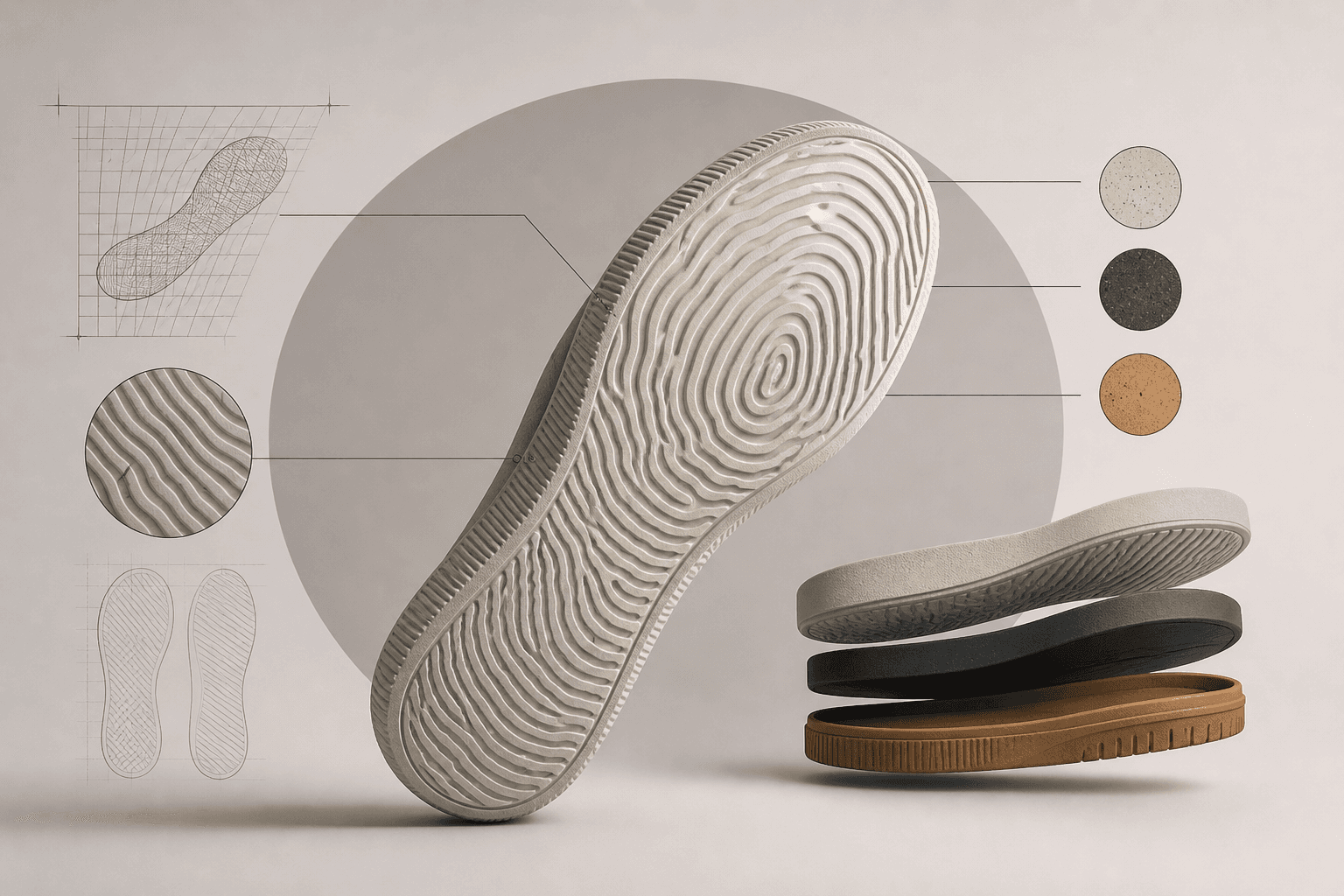
The Problem
A footwear brand approached us after discovering that one of their outsole designs became slippery under certain conditions.
The issue was especially noticeable on smooth or slightly wet surfaces.
The outsole looked visually strong. The design was unique, clean, and aligned with the brand identity.
But performance testing revealed a serious risk:
Poor wet grip
Limited floor contact
Unsafe slip resistance levels
This created a real product concern that could not be ignored.
Why the Outsole Became Slippery
After reviewing the outsole structure and running technical evaluations, we identified several root causes.
1. Limited Contact Area
The outsole pattern had minimal surface contact with the ground, reducing friction during movement.
2. Pattern Direction Followed Walking Motion
The original grooves flowed in the same direction as walking movement, which reduced resistance during forward motion.
3. Material Hardness Requirements
The outsole used a multi-color construction.
To prevent color bleeding between sections, the base material needed to remain harder than ideal. This negatively affected grip performance.
Testing the Outsole
We conducted slip resistance testing using industry-standard evaluation methods.
Testing Standard
ISO 13287 slip resistance testing was used to measure outsole friction under:
Dry conditions
Wet conditions
Original Test Results
The original outsole produced:
Dry coefficient: 0.4
Wet coefficient: 0.2
These results represented a high slip risk, especially in wet conditions.
Our Development Process
Instead of applying a quick fix, we rebuilt the outsole performance step by step.
Stage 1: Texture Modification
We first experimented with additional surface textures and rougher contact patterns.
This included:
Granular textures
Grid-like structures
Rougher surface contact zones
The improvement was moderate:
Dry coefficient improved to 0.6
Wet coefficient improved to 0.4
Better, but still not ideal.
Stage 2: Pattern Direction Engineering
Next, we redesigned the groove direction.
Instead of flowing with the walking motion, fine lines were adjusted to run more perpendicular to movement.
This created:
More resistance during motion
Better traction
Improved surface grip
At the same time, we adjusted the outsole formula to improve softness and flexibility.
Final Test Results
After redesigning both:
Pattern structure
Material formula
The outsole achieved:
Dry coefficient: 0.9
Wet coefficient: 0.5
This created a significantly safer outsole system.
The Trade-Off
Improving performance also created new technical considerations.
Because the outsole became softer:
Color bleeding risk increased between outsole sections
Additional groove depth was required
Pigment adjustments had to be introduced to manage appearance issues
To reduce this risk, we:
Increased outsole thickness by 1–1.5mm
Deepened separation grooves between colors
This helped reduce visual bleeding while maintaining improved grip performance.
Key Takeaway
Many brands assume outsole performance is only about rubber material.
In reality, grip performance depends on:
Pattern engineering
Contact area
Groove direction
Material hardness
Construction limitations
Small design decisions can completely change how safe a product feels in real-world conditions.
Why This Matters for Footwear Brands
A product can look visually strong and still fail performance expectations.
Without proper testing:
Slip risks go unnoticed
Customer complaints increase
Safety concerns appear after launch
This is why requires technical validation before mass production. Design alone isn't enough.
Final Thought
Good footwear is about balancing these with appearance:
Design
Safety
Manufacturability
Material limitations
Real-world performance
That balance is where most production problems begin.
If you’re developing footwear products and want a solution-oriented teams that solves problems like these, click below to get in touch.